18 August 2026
Czech Film Springboard 2026: The new social imagination
Czech Film Springboard 2026: The new social imagination

A new cohort of Czech filmmakers employ genre, satire, and intimate character studies to examine issues of economic inequality, privilege, faith, family, and belonging. We look at five projects, by documentary and fiction directors alike, using contemporary settings—from the streets of Prague and suburban homes to a BDSM studio and a residential clinic—to turn social tensions into character-driven drama.
by Martin Kudláč for CZECH FILM / Fall 2026
A city at breaking point
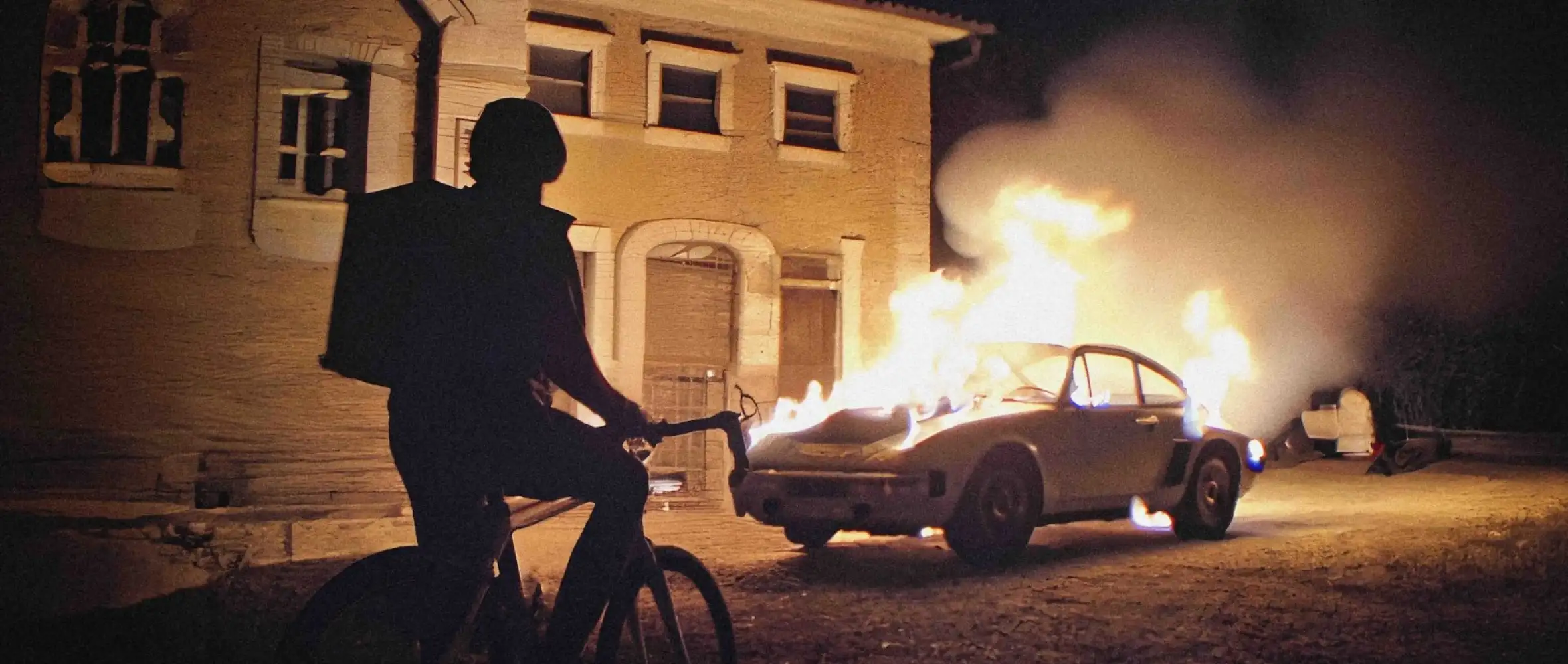
Czech-Swedish filmmaker Greta Stocklassa is at work on her feature debut, Burnout, loosely based on Petr Šesták’s Magnesia Litera–nominated novel of the same name (Vyhoření, 2023). The story follows Kryštof, a food delivery biker in his late thirties, whose daily rounds through Prague expose him to the city’s inequalities, hostility, and increasingly politicized struggle over public space. Delivering meals across sharply divided social worlds, Kryštof experiences economic precarity as a daily physical strain. At first, his relationship with Klára, an art student involved in environmental activism, offers him a sense of purpose. However, he soon recognizes that for her protest is a choice, while for him it’s an existential necessity. As his frustration intensifies, he is drawn to a more radical group, and the distinction between resistance and violence begins to collapse.
For producer Marek Novák, the project’s central concern is the changing meaning of freedom in postsocialist Central Europe. Burnout examines how mobility and the use of public space have become markers of political identity and cultural conflict, while asking whether freedom can exist without responsibility to others. Technically, Stocklassa seeks to infuse staged fiction with the immediacy of her documentary practice. Protests, crowd scenes, and Kryštof’s movement through the city will be shot in a raw, semidocumentary manner, influenced by Dogme 95, while the character-driven sections will take a more controlled narrative approach. Stocklassa is cowriting the screenplay with Veronika Dvorská, her collaborator on the Czech Lion–winning short Buzz of the Earth.
Produced by Novák’s Xova Film, Burnout is in early development, with a first draft of the screenplay expected in summer 2026. German and Swedish coproducers are in discussion, and Novák is considering a variety of international development platforms. Stocklassa and her project have been selected to participate in this year’s Locarno Residency. Production is tentatively planned for 2028, with completion targeted for spring 2029.
Progressive parenting, class-blind spots
While Burnout maps conflict across the space of a city, Jakub Jirásek’s feature debut, The Delivery, compresses generational and class tensions into an upper-middle-class villa over a Saturday afternoon. Conceived as a social comedy, the film uses a teenage relationship to expose the limits of supposedly progressive parenting. The 15-year-old Nikola lives with her affluent parents, who see themselves as liberal, informed, socially responsible. Their self-image is disrupted when Nikola’s classmate David, a food courier from a less privileged background, enters the family villa. As the connection between him and Nikola oscillates between suspicion, embarrassment, and attraction, the adults’ attempts to demonstrate tolerance reveal a more deeply rooted paternalism. The gig economy puts their convictions to the test when Nikola’s father takes over David’s delivery shift, treating the precarious job as something to briefly experience, then leave behind.
Cowritten by Jirásek and Ondřej Kopřiva, The Delivery centers on the generation and class gap, with Nikola and David forming its dramatic core. Their developing attachment lends the story a dimension beyond satire, while the family setting allows the film to examine how liberal values coexist with unacknowledged privilege and conservative reflexes. Jirásek aims for an intelligent, postironic humor, balanced between comedy and discomfort: moments that are funny precisely because no one—the characters or the audience—can be certain where the sincerity ends and embarrassment begins. Tonal references include Ruben Östlund, Greta Gerwig’s Lady Bird, and Jesse Eisenberg’s When You Finish Saving the World, though Jirásek strives for his work to be less formalized and more accessible, balancing arthouse observation with genre elements. Classical cinematography will be combined with phone footage generated during the shoot, including a music video made inside the house.
Produced by Marek Dusil of Mannschaft, The Delivery is aimed primarily at moviegoers aged 15–25, with parents aged 40–55 forming a secondary audience. Ideally, the two groups will watch the film together, with Gen Z attending alongside their parents. The production is conceived as an international coproduction, with a Slovak partner among the likely collaborators and further discussions involving companies in Germany, Romania, and France. Shooting is provisionally planned for 2027 on a compact schedule of 15 to 20 days.
Control behind the mask
Documentary filmmaker Barbora Chalupová makes her fiction feature debut with Madam, an intimate contemporary drama combining social realism, tenderness, and dry humor. Centered on a professional dominatrix in her mid 30s, the film explores loneliness, family expectations, and the difficulty of sustaining closeness without surrendering control.
Nela spends her nights as Madam Chimera, driving a black Saab 900 and working in a world of clearly defined boundaries and emotional distance. Although clients often treat her as a therapist, Nela shields herself behind a mask of authority. In private, she lives alone, caring for her tortoises and longing for intimacy, while Nela’s mother struggles to accept her daughter’s choices. Aware her fertility will soon start to decline, Nela decides to freeze her eggs. Over the three months of preparation, her carefully guarded boundaries begin to soften.
When Václav, a renowned architect accustomed to power, asks Nela to play his estranged daughter, it resonates with her history of paternal abandonment, drawing her into an emotionally ambiguous relationship. Meanwhile her neighbor Diana appears to embody the family life Nela desires, while Ondřej, a divorced mechanic and devoted father, offers a prospect of intimacy without pretense. Both relationships expose the limits of apparent acceptance, forcing Nela to reconsider what kind of closeness and future she really wants.
Developed through two years of research in the professional BDSM community, Madam marks Chalupová’s transition from documentary (including Caught in the Net, the most attended Czech documentary in history) to fiction. The movie challenges reductive depictions of sex work, with Nela neither femme fatale nor victim, but an ordinary woman balancing work, intimacy, and social expectations. Real clients and nonprofessional performers appear alongside actors, with a practicing dominatrix advising them on choreography. Rather than using BDSM as spectacle, Madam examines power, control, solitude, and vulnerability.
Chalupová combines improvisation and naturalistic performance with a stylized visual concept informed by independent filmmakers Andrea Arnold and Sean Baker. Shot entirely on two mobile phones, the film embraces their raw immediacy, contrasting suburban housing estates with the controlled interiors of the BDSM studio. Completion is expected in January 2027. Produced by Eva Rejč and Pavla Klimešová of Helium Film, the project is seeking sales representation, distribution partners, sponsors, and festival programmers.
Faith under pressure
Vojtěch Novotný’s feature debut, God Break Down the Door, is a drama with thriller elements and darkly comic undertones, centered on an unlikely protagonist: Bob, an overweight, devoutly Catholic 18-year-old, whose desire to be good is gradually undermined by humiliation, manipulation, and guilt. Sent to a residential treatment center to lose weight, Bob shares a room with Vítek, a chronically ill nihilist whose worldview is the opposite of his. During his stay, Bob develops feelings for a young intern named Káťa. When she rejects him, he strikes back with an act of retaliation that leaves her in a coma. Vítek exploits Bob’s guilt, asking him to help him die and, in return, offering to take responsibility for Káťa’s poisoning.
Written by Vojtěch Novotný, the film treats faith neither as something to be ridiculed nor as a source of moral certainty. Instead it examines belief as an internally conflicted force, alongside body image, self-acceptance, emotional dependency, and the mechanisms by which vulnerable young men can be manipulated. The humor emerges primarily from the contrast between Bob and Vítek, preventing the film from collapsing into unrelenting darkness. Producer Tomáš Pertold of Perfilm intends God Break Down the Door for younger and festival audiences interested in morally ambiguous character dramas. The two central roles are expected to be cast with newcomers, while established actors are planned for some of the adult parts. Tonal and thematic references include Corpus Christi, First Reformed, and Corpo Celeste. The Czech-Slovak-Lithuanian coproduction is backed in development by the Czech Audiovisual Fund and Creative Europe MEDIA. Slovak producer Anna Mach Rumanová is attached, with a Lithuanian partner in discussion. The project previously took part in MIDPOINT Feature Launch, where it received the Rotterdam Lab Award, and was later presented at the Agora Crossroads Co-production Forum, in Thessaloniki. The producer is aiming to shoot in summer 2027, with completion and premiere planned for 2028.
Children leading adults home
Albert Hospodářský’s next feature, Bruised Knees, brings mystery and spiritism to a winter day on Prague’s outskirts, where an impending birth and unresolved grief connect through parallel stories. With his girlfriend about to have a child, Niko, a 25-year-old Romani man, is doing his best to stay away from home. After rescuing two unruly children from security guards in a shopping center, he sets out with them to find where they belong, using it as an excuse to avoid his responsibilities. Gradually, the dynamic reverses: the children recognize that Niko is the one who’s lost and start to guide him home. In a parallel storyline, the single mother Selma agrees to a séance to help her 8-year-old son contact his deceased father. These two strands converge in a single apartment building: while downstairs the family attempts to reach the dead, upstairs Niko witnesses his daughter enter the world.
Hospodářský’s film—cowritten with his mother, the playwright and dramaturg Eva Prchalová—employs two deliberately contrasting modes. Niko’s storyline is conceived in a kinetic, run-and-gun style, akin to the raw immediacy of Sean Baker’s Tangerine. Selma’s apartment-bound strand, on the other hand, is more dialogue-heavy and actor-led, possessing the psychological focus and spirituality of Ingmar Bergman. Hospodářský intends to shoot on mobile phones, to achieve a visual and emotional effect between guerrilla realism and chamber drama.
As in his debut, Brutal Heat, which received a Special Jury Mention in Karlovy Vary’s Proxima competition, Hospodářský here uses a heightened premise to explore uncertainty, as childhood becomes a route back to mystery in a hyper-rational world. The children’s unruliness and intuition force the adults to listen, relinquish control, and grow. Produced by Ondřej Lukeš of Beginner’s Mind, Bruised Knees is being developed through MIDPOINT. Principal photography is set for winter 2027–2028, with completion expected in summer 2028. The producer is seeking a sales agent, distributors, and streaming partners, with scope for one international coproducer.