10 August 2026
Costumes can speak!
Costumes can speak!

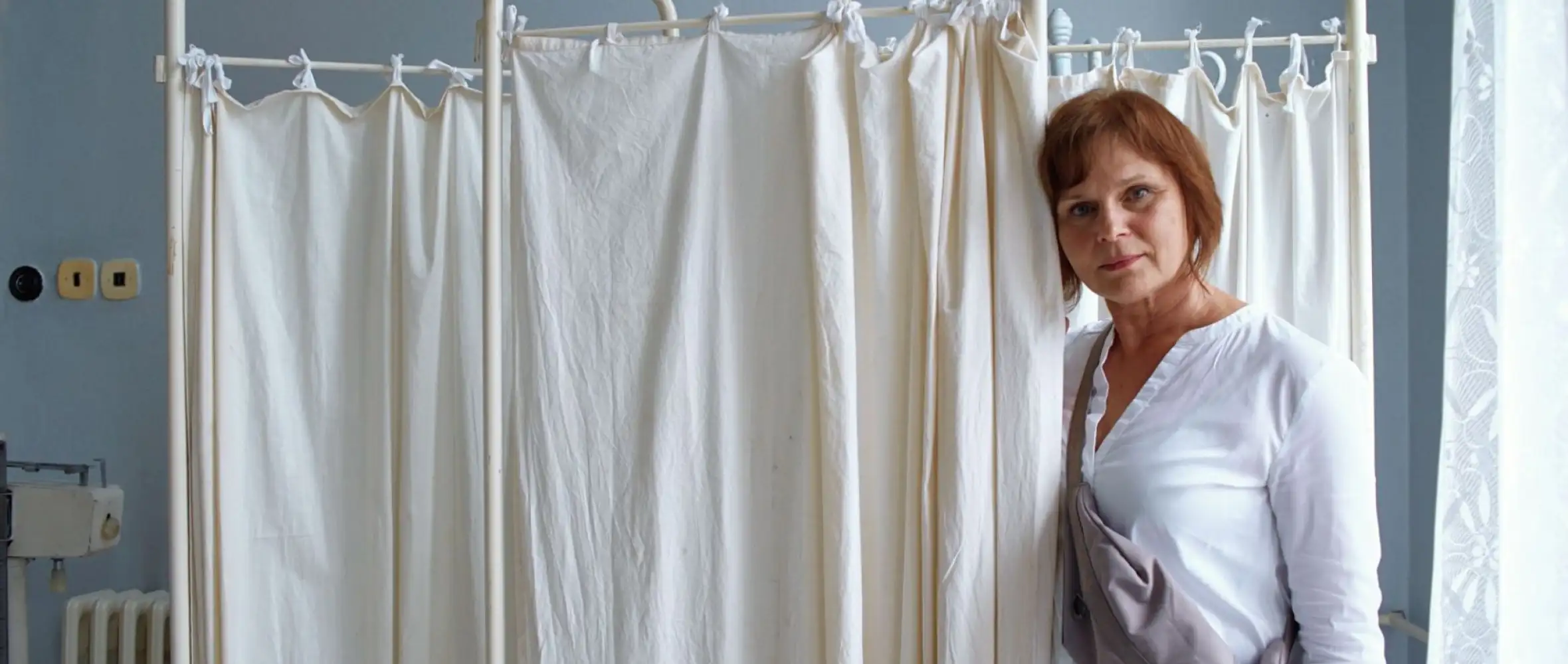
Costume designer Katarína Hollá (*1963) studied set design at DAMU in Prague and has “dressed” characters in fifty films, including the Oscar-winning Kolya. She has collaborated regularly with filmmakers such as Martin Šulík, Alice Nellis, Jan Hřebejk, and Ivan Ostrochovský. Hollá is also credited in Ostrochovský’s new film Only Beautiful Things to Look At, in which Anna Geislerová plays Ingrid, a gynecologist who performs sterilizations on Romani women in Czechoslovakia in the 1980s. In addition to her work in film, Hollá has designed costumes for more than 250 theater productions.
by Vojtěch Rynda for CZECH FILM / Fall 2026
Only Beautiful Things to Look At combines the atmosphere of a spa town at the turn of the 19th and 20th centuries, the 1980s in communist Czechoslovakia, a medical setting, and the Romani community. How do you create costumes for a film like this?
The costumes in Only Beautiful Things to Look At are very understated – almost documentary-like. I don´t mean Anna’s costumes, but the outfits of the Romani characters. Several viewers thought that they simply showed up wearing their everyday clothes. But even that takes a lot of work – to make a costume look inconspicuous and natural to the point where it doesn't even look like a costume. Almost all of the Romani actors wore costumes, though; no one appeared in their own clothes.
How did you make the Romani characters' costumes look authentic?
In their case, we didn’t have to stick strictly to a specific era. Romani culture is elusive and defies categorization, which allowed us to use timeless costumes and, in some cases, colors with symbolic meaning. Years ago, while filming Gypsy with Martin Šulík, we lived in a Romani settlement for six weeks. During that time, I gained insight into the Romani mindset and learned about their clothing conventions.
A medical setting means uniforms; I imagine working with them is restrictive. How did you cope?
Simply put – even within those constraints, there is always some space for freedom. The basic color of nurses’ uniforms at that time was blue and white, but one nurse might wear an apron while another might not... Moreover, the blue-and-white color scheme complemented the hospital setting, with blue or greenish tiles on the walls, so I played with the connection to the set design as well. Blue also worked beautifully on a symbolic level. In one scene, for example, a woman wearing a blue nurse's uniform is holding a naked baby, and thanks to the composition, there are clear allusions to the Virgin Mary.
How did you approach the costumes in the dream sequences, such as the one with the dead deer or the giant flower?
Ivan and I agreed that Anna should wear her pajamas in those scenes to offer a glimpse into her personal life and inner self. And that the fabric should be flowy to convey vulnerability, a feeling that we also emphasized through the color palette.
Ingrid’s costume resonates with the dreamlike, beautiful veranda at the house in Leháry, where we often see her. Did you explore the locations in advance to match the costumes to them?
Before I start working on costumes, I always want to know the setting in which they will appear. It’s very important to me. With Only Beautiful Things to Look At, for example, I wanted to see pictures of the interiors. The specific features of an interior, such as a large fresco or a dominant color scheme, can have an impact on the costumes; for example, you can’t have an actor in a red costume standing in front of a red wall. I also wanted to see the natural surroundings where the film was to be shot.
How did that work in the scene where the abortion committee met in a beautiful room with stucco walls?
For one of the characters, for example, I had three differently colored blouses ready. After consulting with Ivan, I always have the option of making slight changes to the costume, such as using a different accent color if I feel it works better, swapping things out or adding accessories like scarves. I enjoy going to the set and think of our work as adding the finishing touches to a painting. During my studies of set design, we focused a lot on painting. Professor Smutný taught us that, in set design, you should view each scene as a painting. Take in the whole picture.
You’ve also collaborated with Ivan Ostrochovský on 107 Mothers and Servants. What makes working with him unique?
Ivan is an exceptional person. Generous and calm. He knows what he wants. The longer I’ve been in this profession, the more important it has become for me to have someone by my side whom I can trust completely, who I can fully rely on. I also value a reliable team, which is why I return to tried-and-tested collaborations with people I’ve worked with for a long time.
What genre suits you best? Realistic contemporary films, visually stylized films, retro films...?
I don’t like routine, which is why I combine film work with theater. I don’t think I’ve ever done any truly grand cinematic stylizations, except for Horror Story by Jaroslav Brabec, based on Josef Váchal’s novel. However, I do switch between genres. But for me, the theme, the team, and the director are more important than whether the film is contemporary or retro. What I need is to have confidence in the people I’m working with.
After Only Beautiful Things to Look At you worked on the contemporary comedy Něco jako Rodina. What’s your next film project?
For the first time in my life, I am consciously and happily taking on a TV series – a crime drama directed by Alice Nellis, with the working title Marika. It’s an eight-episode project produced for TV Prima by Pozitiv Films production company, run by Ondřej Zach and Klára Bukovská. Another film with Martin Šulík is also on the horizon, and of course I have plenty of theater work.
With such a heavy workload, how big is your team?
My core team consists of myself and two costume designers who I have worked with for many years. For a standard-length film, this is a sufficient team. However, for a production like The Burning Bush by Agnieszka Holland, you need at least ten people. You simply can’t dress a hundred extras by yourself. Another major project like that was 3 Seasons in Hell by Tomáš Mašín.
How can a costume designer enrich a contemporary film?
Some people might think that actors in today's films just wear whatever they bring from home. However, I sometimes find it more challenging to design costumes for contemporary films than for period pieces. With period films, hardly anyone knows exactly what the costumes should look like, but when it comes to clothing from the present day, everyone is an expert. I prefer subtle, meticulous work, where you focus on the details rather than “painting with a broad brush”. This could be based on my understanding of the character’s personality, for instance, or in collaboration with the cinematographer and production designer.
Do you talk to the actors about their vision for the costume and what would suit them?
Of course. I don’t ask actors specifically what costume they want me to dress them in, but I do want to know how they feel in it, who they are, what they want to express, what their character's inner world is like. When an actor is able to articulate that, the costume just falls into place: suddenly you see it, and there’s nothing left to discuss. I like to think of actors as partners, but not all of them realize that a costume can help – but also harm them.
Are there any techniques that can help actors?
There are plenty of little tricks that can help actors with both their physical and psychological expression. For example, having a pebble in your shoe can make you limp. Similarly, wearing high heels and a corset can make an actress radiate a completely different energy. Although the corset isn't visible, it changes the way the actress stands and breath. Officers also wore corsets under their uniforms. Uniforms used to be padded and quilted to create a "pigeon chest" and an appearance of physical perfection. In short, a costume speaks for itself.