
01 August 2026
Silk Films: From boutique scale with European horizon
Silk Films: From boutique scale with European horizon

Prague-based independent outfit Silk Films, helmed by producers Alžběta Janáčková and Martina Štrunc, balances the creative focus of a boutique studio with an internationally minded co-production strategy. Spanning authored fiction, socio-political documentary, and upcoming small-screen series, the company’s slate is bound by a shared investigation into media exposure, social expectation, and private identity.
by Martin Kudláč for CZECH FILM / Fall 2026
Prague-based independent production company Silk Films combines the close creative involvement of a boutique producer with a slate spanning authored fiction, socially engaged documentary and international minority co-production. Rather than separating these activities into distinct production identities, the company brings them together through a shared interest. This allows Silk Films to move from intimate contemporary drama to portraits of Czech public life and politically grounded European projects without appearing either narrowly specialized or indiscriminately broad.
The company is headed by Alžběta Janáčková and Martina Štrunc. Janáčková focuses primarily on fiction and international minority co-productions, developing partnerships around projects with international potential and distinctive directorial voices. Štrunc leads much of the company’s documentary work, collaborating with filmmakers whose subjects engage with contemporary Czech society, cultural identity and public debate.
Their complementary roles allow Silk Films to operate across different formats without losing a coherent editorial sensibility. Across its fiction and documentary work, the company repeatedly examines the distance between public image and private experience, and the ways individuals respond to family expectations, social roles, political pressure and the need for self-invention. That sensibility is now being carried into a more sustained small-screen slate, as Silk Films expands beyond feature-length production into factual and scripted series with broader international and public-service broadcasting structures.
Character-driven fiction meets social-impact docs
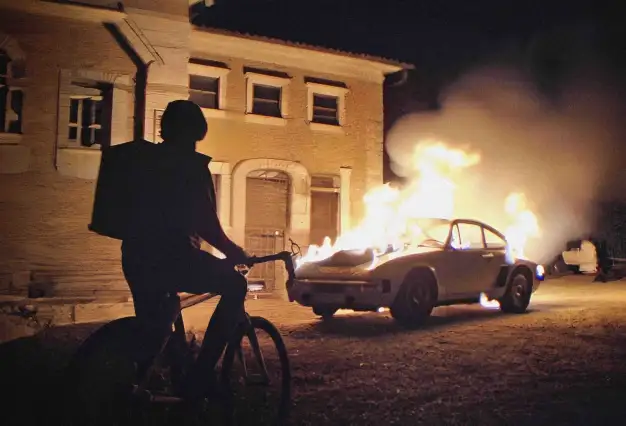
Silk Films’ fiction profile is most clearly represented by its work with director Šimon Holý. His latest feature Chica Checa world-premiered in the main competition of the Karlovy Vary lFF 2026. Pavla Tomicová stars as Zdena, a widowed postal worker in a small Czech village whose son Lukáš returns from France to fulfil his dying grandmother’s wish to see Helena Vondráčková, a household-name Czech pop singer. Unable to arrange the meeting, Lukáš impersonates the star himself, revealing that the respectable life he has described abroad conceals his career as the Paris-based drag performer Chica Checa. Holý treats Lukáš’s return not simply as a coming-out story, but as the catalyst for Zdena’s own emotional reawakening. The film avoids presenting the village as a predictable site of scandal and instead focuses on the private work of grief, acceptance and reconciliation. Its intergenerational structure gives equal importance to Lukáš’s self-invention and to Zdena’s gradual recognition that her own life may still contain new possibilities. Produced by Janáčková with partners in France and Slovakia and with the involvement of Czech public broadcaster Czech Television. The Berlin-based sales agent Pluto Films is handling the international rights.
The film continues Silk Films’ relationship with Holý following his feature debut, Mirrors in the Dark. Built around the well-known set of 36 questions designed to accelerate intimacy between strangers, the film follows a dancer approaching 30 as she reconsiders her relationship, career and sense of achievement. Its contained production model and dialogue-led construction turn the crisis of one couple into a broader study of ambition, emotional compromise and the fear of mediocrity. Where Chica Checa adopts the warmer form of an intergenerational dramedy, Mirrors in the Dark is more austere and DIY.
Silk Films’ documentary identity is defined by a related interest in private lives entering the public arena. In Karlos (2024), directed by Michal Samir and Šimon Šafránek, the subject is mixed martial arts fighter Karel Vémola, the first Czech athlete to compete in the UFC and one of the country’s most visible sporting celebrities. The film approaches Vémola as athlete, family man and self-created media personality. His extravagant home, exotic animals and public relationships form part of a wider portrait of an attention economy in which domestic life becomes an extension of personal branding.
Robin Kvapil’s documentary portrait Citizen Miko (2023) offers a counterpoint. The observational documentary follows truck driver and activist Jaroslav Miko, co-founder of the Czech Help initiative and an advocate for accepting child refugees. His Romani background and activism within a milieu rarely associated with progressive politics place him in conflict with assumptions held by those around him. Where Karlos examines a personality enlarged by media exposure, Citizen Miko follows an ordinary citizen who chooses to assume a public role. Together, the films demonstrate Silk Films’ interest in how individuals become symbols through celebrity, activism and social conflict.
Alongside its domestic fiction and documentary work, Silk Films has developed a role as an international minority co-producer, joining projects whose political and artistic concerns align with the company’s broader sensibility. This strand allows Janáčková to extend Silk Films’ producer-led approach beyond Czech-originated stories, building partnerships across territories while supporting films with strong directorial identities and subjects rooted in specific national histories. Ivan Tymchenko’s Oxygen Station (2023), made with Ukrainian, Slovak and Swedish partners, is a key example. Set in the Soviet Union in 1980, the film follows three people travelling towards Crimean Tatar human-rights activist and political prisoner Mustafa Jemilev, then exiled in Siberia. The project places personal experience within a wider history of displacement, repression and resistance, while positioning Silk Films within a politically grounded European co-production. Although the story originates outside the Czech Republic, its focus on individuals shaped by ideological pressure and public systems connects it closely to the concerns running through the company’s fiction and documentary work.
Cultural histories meet formal experimentation
Silk Films’ broader slate shows how this central sensibility extends into cultural history, political documentary and formal experimentation. Directed by Šimon Šafránek, documentary series RapStory (2021) traces the development of Czech hip-hop from 1989 onwards through artist testimony, private recordings and broadcast archives. Its fast editing and deliberately rough texture present rap as an alternative record of post-socialist transformation, reflecting shifts in language, commerce, aspiration and generational identity. Barbora Chalupová’s documentary The Law of Love (2021) follows the campaign for marriage equality in the Czech Republic across activism, parliamentary negotiation and political resistance. Like Citizen Miko, it approaches institutional conflict through its consequences for individual lives, relationships and social recognition.
The company has also supported projects operating outside conventional fiction and documentary structures. Shot on colorful 16mm stock, docu-essay Personal Life of a Hole (2020) by experimental filmmaker Ondřej Vavřečka uses its central motif to connect ecology, economics, contemporary culture and love through a free-associative, essayistic form. Kilian Kuděla’s Below the Black Sun Rising (2024) moves further into audiovisual abstraction, tracing the image of the black sun across prehistoric spirituality, runic traditions, alchemy, psychoanalysis, occultism and political appropriation. Rather than restricting the symbol to its contemporary extremist associations, the film explores its longer mythological and psychological history, including links to Prague.
A different register within Silk Films’ international co-production work is represented by Division by Zero, directed by North Macedonian filmmaker Gjorce Stavreski. The art-house drama follows a heartbroken mathematician whose psychiatrist encourages him to exchange objects with strangers, setting off a chain of encounters that eventually leads him towards a physicist. Produced by Fragment Film in North Macedonia and co-produced with partners in Bulgaria, Bosnia and Herzegovina and Silk Films, with Janáčková representing the Czech company, the film is currently in post-production. The film is being scheduled for a 2027 release, with festival premieres and international sales representation now being sought.
Scaling up the small-screen and genre pipeline
Silk Films’ development slate suggests how its established interests are evolving into family film, genre and episodic production. Night Butterfly, a family fairy tale in development, centers on a girl whose mother belongs partly to a magical world. When supernatural abilities pass to her younger brother instead of to her, she must complete a series of trials and confront malevolent witches to reunite her divided family. The film´s protagonist is defined partly by what she has not inherited and by the role she believed she would occupy within her family, translating familiar themes of exclusion and self-discovery into a story for younger audiences. Janáčková is looking for a director to helm this already developed project alongside potential co-producers.
A darker extension of the company’s political concerns can be found in Escape Frequency, a fiction feature in development with director Tomáš Mašín. Set in a provincial Czech town, the darkly comic thriller centers on Otto Doubek, a charismatic self-help guru and New Age influencer who convinces hundreds of followers that an approaching asteroid will destroy Earth and that salvation lies in a 66-metre “Vibration Tower” capable of transporting them to another dimension. Behind the apocalyptic rhetoric is a calculated scam built on fear, pseudoscience and the exploitation of online conspiracy culture. As a police investigation begins to expose the machinery behind Doubek’s movement, the story develops into an increasingly chaotic crime plot driven by manipulation, greed and desperation. The producers are in discussions with Scandinavian and Polish co-production partners, with production provisionally planned for late 2028 or early 2029.
The company is also developing Get Lucky, a contemporary dramedy to be directed by emerging filmmaker Terézia Haľamová. Set in Prague over the course of several weeks, the film interweaves three relationship stories shaped by mistrust, mediated intimacy and emotional withholding. One follows a newly formed couple whose relationship is put under unexpected pressure after a pair of lost AirPods triggers a more serious test of trust. The second centres on two OnlyFans creators trying to navigate the end of their relationship while continuing to perform intimacy online. The third follows a single mother of a young child who begins an online relationship with a foreign woman but is afraid to reveal that she has a child. Merging humor and sharp social observation, the project explores how digital culture, public performance, and the fear of genuine vulnerability shape today´s relationships. The principal photography is preliminary set for 2028 while the producers remain open to additional co-producers.
The company is also expanding into episodic factual production with Treasures of the Amber Road, a five-part docuseries spearheaded by Czech Television in co-production with Polish public television. Originating from a documentary concept by Tomáš Kratochvíl, director of the acclaimed experimental archaeology documentary Prehistoric Seafarers, the miniseries spans Czech, Polish, and Slovenian territories and involves extensive international location shooting. Treasures of the Amber Road will explore Europe’s oldest major trade superhighway. Tracing the ancient route that linked the Baltic Sea to the Mediterranean and Adriatic, the show investigates the flow of "Northern Gold" (Baltic amber), ancient craftsmanship, and cultural exchange across Central and Southern Europe. To bring lost heritage to life, the series will utilize advanced AI-assisted visual reconstruction to recreate historical sites and landscapes that no longer exist. Slated for principal photography in 2027, Treasures of the Amber Road marks a major step for Silk Films toward large-scale public-service television. The project remains open to additional co-producers, broadcast partners, and sales agents.
Extending her role beyond producing, Martina Štrunc is currently developing her directorial debut, a documentary tracking Czech war photographer and videographer Jana Andert during her coverage of the Russo-Ukrainian war. The project explores the fine line between personal witness and public reporting in contemporary conflict zones.
Looking ahead, Silk Films is strategically pivoting toward an expanded small-screen slate. Alongside several episodic projects currently in deep development, the company plans to broaden its slate by moving into original crime genre series, a natural extension of its interest in high-concept, tension-driven narratives. To manage this growing production pipeline and rising workload, Janáčková is actively seeking to hire a junior producer to join the Silk Films team, reinforcing the boutique company’s capacity as it steps into its next phase of international and episodic production.