14 January 2025
Oscar recognition for creative partnership
Oscar recognition for creative partnership

Two graduates from the Miroslav Ondříček Film Academy (FAMO) in Písek, Pavel Sýkora and Viktor Horák, made history for the school when their short film The Compatriot netted the Student Oscar in the live-action film category. Their achievement marks the first such milestone for FAMO and the fourth time a Czech student project has won in the US award’s 50-year history. The Compatriot beat out more than 2,600 competitors from hundreds of art schools around the world. Even more exciting, the work has been shortlisted in the Best Live Action Short Film category for the 97th Academy Awards.
by Martin Kudláč for CZECH FILM / Spring 2025
From classroom to Oscar stage
Pavel Sýkora and Viktor Horák, codirectors of the award-winning short film The Compatriot, have unconventional backgrounds for filmmakers. Neither one studied directing at FAMO—Horák’s focus was screenwriting, while Sýkora studied cinematography—and their collaboration began informally, through assisting on projects by fellow students.
The Compatriot is not their first joint effort. The duo previously worked together on To My Future Self (2022), a visually driven, atmospheric short film about a sex worker. On both projects, Sýkora served as cinematographer. Despite their lack of formal training in directing, both have attended classes on the subject. However, they share the belief that there is no definitive blueprint for directing, seeing it as an organic, evolving process that relies on intuition and adaptability.
The idea for The Compatriot originated with Sýkora, but the screenplay was written by their colleague Petr Pelech, who also collaborated with them on To My Future Self. Pelech has a particularly close working relationship with Horák, having partnered with him on several other projects. The directing duo deliberately chose not to helm their own screenplay, a decision they say allowed for greater creative objectivity. Horák notes that as codirectors, their differing perspectives sometimes require mediation, and having a third creative voice, like Pelech’s, helps resolve dilemmas and ensure the best possible outcome.
Their foray into directing was born as much from necessity as from creative passion. “Resources at our school were limited,” said Sýkora. “We knew early on that The Compatriot had to work with minimal means: one location, two characters, and a strong script.” Horák added, “We wanted to prove that a compelling story doesn’t require a blockbuster budget.”
The making of The Compatriot
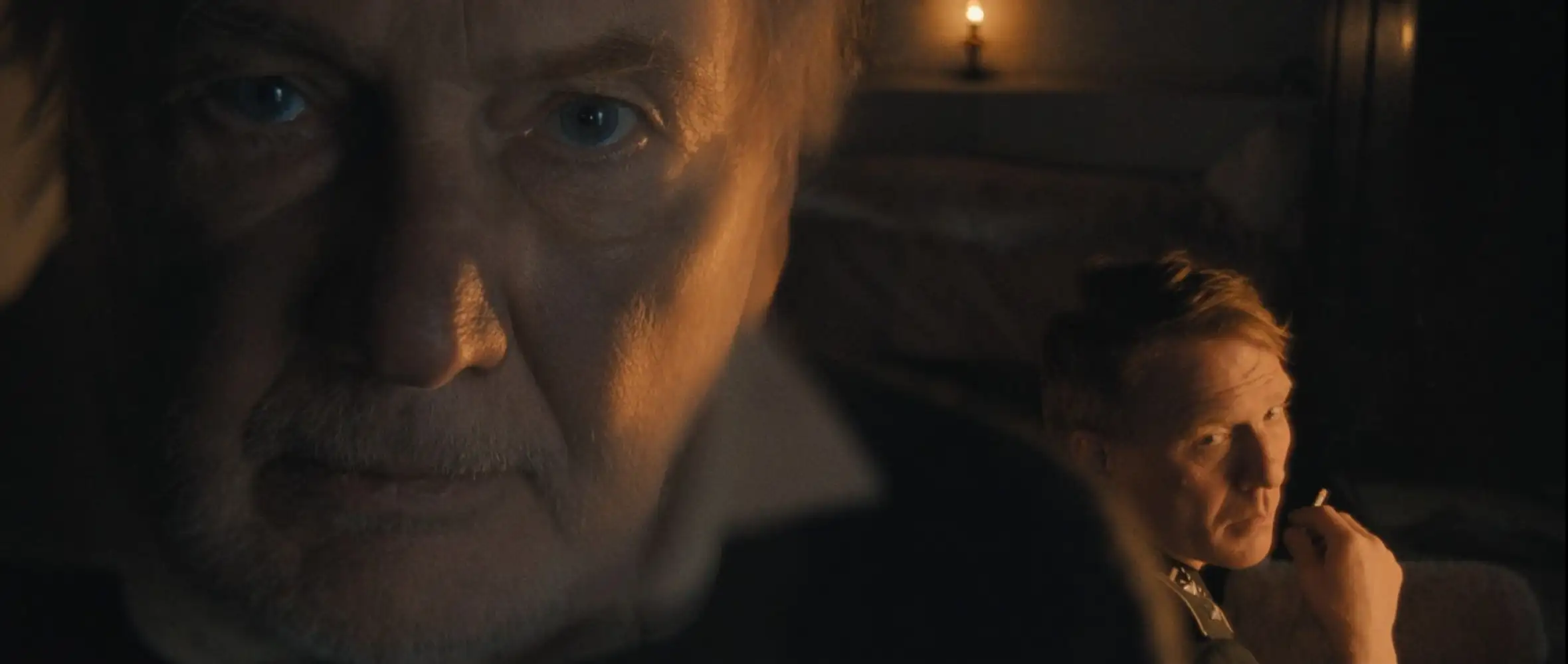
Set during the final New Year’s Eve of World War II, The Compatriot takes place in the Sudetenland, the area of former Czechoslovakia bordering on Germany, where an elderly Czech widower receives an unexpected visit from a German SS officer. This psychological, dialogue-driven drama delves into themes of guilt, survival, and the moral ambiguities of wartime existence.
Filmed in March 2023 over four nights in a remote open-air museum, the production faced significant logistical challenges. “The location lacked electricity, heating, and running water,” said Sýkora. These harsh conditions, however, became an asset to the film’s atmosphere. “It was freezing, but that only added to the authenticity,” added Horák, highlighting how the physical discomfort helped to feed the film’s realism.
The cast includes veteran actor Jiří Štěpnička as the widower Petr Bernat, opposite Pavel Batěk as SS officer Konrad Neumann. “Working with Štěpnička was both intimidating and inspiring,” admitted Horák. “He’s a legend, and his personal history—rooted in themes of exile—brought depth to his portrayal of Bernat.” Batěk’s nuanced performance complements this dynamic, creating a tension-filled interplay that drives the story.
Securing funding for the film was another significant hurdle. The team pieced together their budget from local grants, including support from the Plzeň Film Office, alongside crowdfunding efforts and contributions from friends, family, and sponsors.
While The Compatriot has drawn comparisons to Quentin Tarantino’s Inglourious Basterds (2009), the directors stress that this association primarily applied to the film’s initial concept, which was closer in spirit to Anthropoid (2016). Over time, their vision evolved. “Our influences were more diverse,” explained Sýkora. “We were inspired by works that emphasize dialogue and tension, like The Hateful Eight (2015) or the Czech series Czech Century (2013–14). The focus was always on meaningful character interactions.”
The decision to set the story in the Sudetenland was personal. “I grew up near the border, where the legacy of displacement and conflict remains palpable,” Horák reflected. This historical resonance, paired with contemporary parallels, shaped the film’s thematic direction. “We wanted The Compatriot to transcend its historical setting and speak to ongoing conflicts, like those in Ukraine and the Middle East,” Sýkora added.
Emerging careers
While Horák and Sýkora created The Compatriot as students, their experience extends beyond academia into the professional audiovisual industry. Horák, primarily focused on screenwriting, made his debut as a writer with Barbora Kočičková’s television sports documentary Fabulous Men on Two Wheels (2024). Over the years, he has gained practical experience working as a runner and assistant director on various projects, as well as having served as a script supervisor on F. A. Brabec’s film Gump (2021), the local VOD series Mužketýři (2021–22), and the David Laňka and Martin Müller drama Together (2022). He also worked as a camera trainee on Taika Waititi’s Oscar-winning Jojo Rabbit (2019), filmed in the Czech Republic.
Similarly, Sýkora gained industry experience through roles as a runner and, later, a lighting operator and camera assistant. His credits include Matěj Balcar’s comedy The Gentlemen’s Club (2022), David Laňka’s Runaway (2024), and several domestic television soap operas.
Following the success of The Compatriot, which is being invited to international film festivals, the duo is working on their first feature-length film. Maintaining their minimalist approach, the project is set in a 24-hour bar over a single night and focuses on two central characters. Shifting to a contemporary setting, the film examines how social media and online phenomena influence personal relationships and identity. “It’s a coming-of-age story for the digital era,” said Horák. The script is in development as they seek producers and funding.
In parallel, Sýkora and Horák are working a limited series centered on the high school sports scene in Plzeň. Inspired by a real-life event, the series addresses ambition, social media pressures, and the darker aspects of youth culture. “It’s a mix of sports coming-of-age and social drama,” said Sýkora. Both projects aim to explore universally resonant topics, transcending their Czech context, though they plan to film locally. The filmmakers are also considering international coproduction opportunities.
The duo has formed a stable creative team, continuing their collaboration with screenwriter Petr Pelech and editor Lukáš Skalník. “We’ve found a dynamic that works,” said Horák. Still, both directors also intend to pursue individual projects alongside their shared efforts. Horák has three solo screenwriting projects in development, with plans to involve Sýkora as cinematographer when appropriate. Meanwhile, Sýkora aims to continue building his career in cinematography and has a few projects outside their partnership in the works.
Their win at the Student Academy Awards has made them eligible to compete for the 97th American Academy Awards, and they are awaiting the results to see if their film will qualify alongside professional works. Despite their growing recognition, the pair remains pragmatic about their future. “We’re focused on what we’ve started together, but we’re open to exploring other partnerships,” as Horák put it. Balancing collaborative and individual ambitions, they aim to broaden their creative horizons while refining their craft.